 English

Revised GST Rates: Key Updates for Consumers and Businesses
What is GST?
GST, or Goods and Services Tax, is an indirect tax imposed on the supply of goods and services. It is a multi-stage, destination-oriented tax imposed on every value addition, replacing multiple indirect taxes, including VAT, excise duty, service taxes, etc. Goods and services are included under a single domestic indirect taxation law for the whole of India. In this regime, tax is charged at each point of sale.
Looking for reliable GST consultants in Kochi, Kerala? Whether you’re a startup, SME, or established business, expert GST consultant like VBV ensures seamless registration, accurate return filing, and ITC optimization. Get personalized, affordable, and GST support tailored to your business needs.
The Goods and Services Tax (GST) is a single taxation system in India that replaced various indirect taxes such as VAT, excise duty, and service tax. It was implemented to streamline the country’s complicated tax structure and improve overall efficiency. In this post, we’ll go over the current GST rates in India, crucial features you should be aware of, and the recent modifications brought in by the GST reforms announced on September 3, 2025.
GST Reforms 2025: Key Changes in GST Rates Across Categories
India’s GST system has been overhauled into a simpler two-tier rate structure of 5% and 18%, while luxury and sin goods are now taxed at 40% (compared to the earlier multi-slab system of 5%, 12%, 18%, and 28%). Key categories have seen rate reductions: daily essentials have dropped from 12%/18% to 5%, agricultural equipment from 12%/18% to 5%, healthcare services to 5% or exempt, and education services are now fully tax-exempt.
GST on automobiles and electronic appliances has been reduced from 28% to 18%. Additionally, process improvements such as faster refunds and automatic registration have simplified compliance for businesses.
New GST Rates in India (Effective September 22, 2025)
The GST rate structure has been simplified into three core slabs: 0%, 5%, and 18%, with a higher 40% rate specifically applied to luxury and sin goods. This reform aims to reduce taxes on essential and commonly used items, making them more affordable for the public, while also easing tax compliance for businesses.
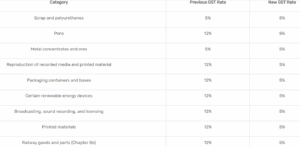
Decrease in the GST rates
To enhance affordability and support social welfare, the GST Council has introduced key rate reductions on essential goods and services.
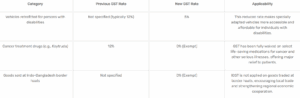
These GST reforms, effective September 22, 2025, mark a significant shift toward a simpler, more equitable tax structure reducing the burden on essential goods and services while maintaining higher rates for luxury and demerit items. By lowering rates on daily necessities, healthcare, education, and key industrial inputs, the government aims to boost affordability, support vulnerable groups, and ease compliance for businesses, ultimately fostering inclusive economic growth.